“`
Meta Title: Top 3 Evidence Types in a Texas Wrongful Death Case
Meta Description: The evidence that decides a Texas wrongful death case: physical proof, witness testimony, and expert analysis. Free consultation with Carabin Shaw.
The Three Most Important Pieces of Evidence in a Texas Wrongful Death Case
The long rural highways and heavy commercial traffic of West Texas produce a steady stream of fatal crashes, and many a Texas wrongful death case begins on one of those roads. A wrongful death case is a civil claim that surviving family members file when another party’s negligence causes a death, and most Texans recognize the term from wrongful death cases in the news. Far fewer understand what it takes to win one. The result of a wrongful death case turns on the strength of your evidence rather than the depth of your loss, which is why knowing the three forms of proof that carry the most weight protects your family’s right to full compensation.
What the Evidence Must Prove
Evidence in a wrongful death case does two jobs: it establishes liability and it proves damages. Liability is the defendant’s legal responsibility for the death, and the proof must tie that party’s conduct directly to the fatal event so a jury can hold them accountable. Every wrongful death claim in Texas attaches to an underlying cause of action — a work fatality pursued alongside a claim on the employer’s insurance, a death from a defective product paired with a product liability suit, or a deadly crash built on a negligence claim. The foundation you choose dictates the specific facts your evidence has to establish.
Because the claim rides on that underlying action, you must prove its elements as well. In a fatal car wreck built on negligence, that means showing the at-fault driver owed a duty of care, breached it, and caused the death — each element backed by its own proof. Missing even one element can sink an otherwise sympathetic case, which is why the evidence has to be mapped to the law from the very start.
Proving Your Damages
The second half of any wrongful death case is damages, the measurable and emotional losses your family carries after the death. Damages evidence has to convince a jury that the defendant’s wrongdoing caused those losses and that the family deserves to recover for them. Lost wages show the income a loved one can no longer contribute to the household, while the loss of companionship, guidance, and care speaks to the harder-to-measure human cost. Strong damages proof is what moves a verdict from a token amount to full and fair compensation.
1. Physical Evidence
Physical evidence is the tangible material that anchors a wrongful death case, and it supports both liability and damages. On liability, the condition of the vehicles, a blown tire, a failed machine part, or the scene itself forms the foundation that shows what the defendant did wrong. Preserving that evidence in the same state it was in right after the event is critical, because a repaired car or a discarded part can erase the proof that explains how your loved one died. 
On damages, physical items carry emotional weight a jury can see and hold. Letters, photographs, and personal mementos document the closeness of the bond you shared with the person you lost, making the depth of your loss concrete rather than abstract. That tangible record helps a jury understand why your family deserves to be compensated.
2. Witness Testimony
Eyewitness testimony from people who saw the event is often decisive on liability. A witness who watched a crash unfold can walk a jury through the sequence of events so they can picture the scene and recognize the defendant’s fault for themselves. A skilled trial attorney shapes that account into a clear, honest narrative the jury can follow without confusion.
Witnesses also speak to damages. Friends, family, and coworkers can describe the emotional devastation a death leaves behind and the daily absence the family now lives with. When a jury can step into your experience and feel that loss, they are far more likely to return a meaningful verdict.
3. Expert Witness Testimony
Expert witnesses translate complex facts into conclusions a jury can trust, and they frequently decide liability in a wrongful death case. An accident reconstruction expert, for example, can show exactly how a collision happened and explain why the defendant is responsible, often after visiting the site to ground the opinion in the real conditions. The right expert depends on the type of case, from engineers to medical specialists.
Experts matter just as much on damages. Economic damages such as lost income and medical costs are tangible and measurable, so a life-care planner or economist can put a defensible number on them. Non-economic damages such as emotional trauma and lost companionship resist easy math, so a psychologist or mental health professional may testify to the lasting toll the death has taken on you.
These three forms of proof are not the only evidence that matters, but they are the backbone of a strong theory of recovery that gives a jury every reason to rule in your favor. Building that record takes an experienced attorney who knows how to gather, preserve, and present each piece before it is lost. Losing a loved one is a devastating experience no family should face alone, and while no award can undo it, fair compensation can lift some of the financial and emotional weight that follows. The attorneys at Carabin Shaw have represented families across El Paso and West Texas in wrongful death claims for many years. If you have lost someone you love, contact the Law Offices of Carabin Shaw for a free consultation.
“`=========
“`
Meta Title: Texas Train Accident Lawyers | Railroad Crossing Injuries
Meta Description: How Texas train accidents really happen at railroad crossings, who can be held liable, and how victims recover. Free consultation with Carabin Shaw.
Cars and Trains: How Texas Train Accidents Really Happen
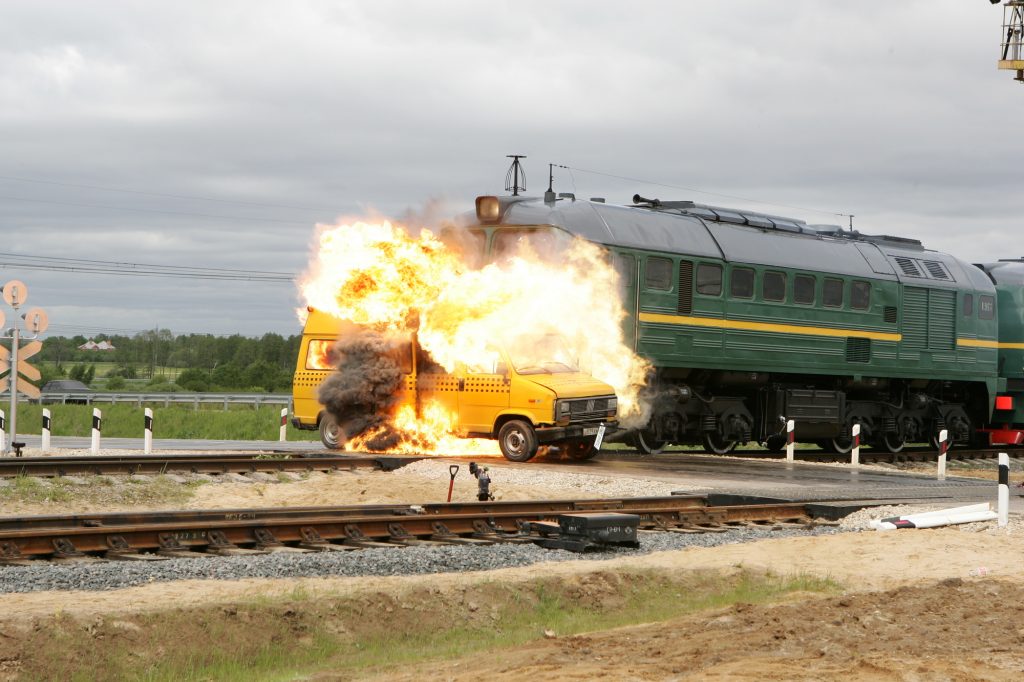
Most people picture a Texas train accident the way movies show it — a car racing a speeding train across the tracks — but the reality is quieter and more troubling. A train accident most often happens when a vehicle ends up on the tracks at the wrong moment, frequently late at night at a dark, poorly marked railroad crossing. Collisions between trains and passenger vehicles occur far more often than the public assumes, and many a train accident traces back to faulty warning systems or no warning equipment at all. Understanding how a train accident actually unfolds is the first step toward knowing who can be held responsible.
For every story about a reckless motorist beating the gates, there are several crashes caused by inadequate protection at the crossing itself. When a railroad fails to warn drivers of the danger — skipping crossing gates, flashing lights, or audible signals — it can be held liable for the injuries and deaths that follow. In many of these cases, the driver who struck the side of a train may bear little or no fault at all.
Everyone Owes a Duty of Care — Railroads Most of All
Texas law holds that we each owe others a duty to act reasonably to avoid causing harm, and that duty rises with the danger involved. A railroad operating 25-ton-plus equipment carries one of the highest duties of care on the road, so the standards it must meet to protect the public are equally high. The flip side benefits victims: when a railroad or its employees fall short of that duty, proving the negligence is often less difficult once the true facts come out.
Right of Way Is Not a Free Pass
Trains usually have the right of way, but that does not let them roll through crossings at unsafe speeds, even on a tight schedule. The operator must use reasonable care, which means slowing through populated areas and watching closely for vehicles and pedestrians. A loaded freight train can need more than a mile to stop even at speeds as low as 30 miles per hour, so reasonable care also means building more visible and audible warning devices where the risk is highest.
What Makes Texas Railroad Crossings So Dangerous
Many Texas crossings sit on rural roads where lighting is poor and warning equipment is outdated or missing entirely. A driver approaching a dark crossing may never see or hear a train until it is too late, especially where vegetation, parked rail cars, or sharp angles block the view. These conditions turn an ordinary drive home into a fatal train accident, and they often point straight to a railroad that failed to keep its crossing reasonably safe.
The Driver Is Rarely the Only Defendant
When a train accident happens, the person at the controls is only the first name on the list, much like the driver in a large semi crash. Others behind the scenes may share the blame, sometimes from miles away — staff at a communications or monitoring center, or the crews who built and maintained the warning signals at the crossing. Under the legal principle of respondeat superior, the railroad as employer is liable for the on-the-job mistakes of its employees, which often puts a well-resourced defendant on the hook for the harm done.
Injuries and the Compensation You Can Recover
The sheer mass of a train means the people involved rarely walk away unharmed. Survivors face broken bones, spinal damage, traumatic brain injuries, and long roads of rehabilitation, while families too often face funeral costs and the loss of a loved one’s income. A successful claim can recover medical bills, lost wages, future care, and compensation for pain and suffering, easing at least the financial weight of a tragedy no one should have to carry. Much of this applies to other rail-related tragedies that injure or kill people who did nothing to cause them, which is why contacting an experienced train accident lawyer as soon as possible matters so much — evidence at a crossing can change or disappear, and an early investigation preserves it.
Our Law Firm has decades of experience handling personal injury litigation in railroad accident cases. If you or a loved one has been hit by one of these huge, lumbering trains, our team works to secure the fairest compensation possible for the injuries and pain you have suffered. We have helped deliver millions of dollars to hundreds of accident victims in Texas, and we are ready to do the same for you wherever in the state your train accident happened. Call us today at 1(800) 862-1260 (toll-free) for a free consultation with our accident attorneys, and begin your road to real recovery.
=============
=================
“`
Meta Title: Types of Compensation in a Personal Injury Lawsuit
Meta Description: From economic and non-economic to punitive and wrongful death damages, see the types of compensation a Texas personal injury lawsuit can recover. Free consult.
Need a personal injury lawyer in Texas? Carabin Shaw offers free consultations and works on a no-win, no-fee basis to protect your rights.
Types of Compensation Available in a Personal Injury Lawsuit
When you file a personal injury lawsuit, the goal is to recover financial compensation for everything the injury cost you. Not all damages are alike, though, and a personal injury lawsuit can carry several distinct types of compensation depending on the facts of your case. Knowing which ones apply to you is the difference between a quick lowball check and the full recovery a personal injury lawsuit is meant to provide.
At Carabin Shaw, we help accident victims across Texas understand their rights and fight for the maximum recovery the law allows. Here is a clear breakdown of the types of compensation you can pursue in a personal injury lawsuit. More about our San Antonio Truck accident attorney here.
1. Economic Damages
Economic damages compensate for concrete financial losses you can prove with bills, receipts, and records. They typically cover:
- Medical expenses — past, current, and future bills tied to the injury.
- Lost wages — income you lost because you could not work after the accident.
- Loss of future earnings — when your injuries limit your ability to earn a living going forward.
- Property damage — the cost to repair or replace your car, phone, or other damaged property.
- Rehabilitation costs — physical therapy, occupational therapy, and other recovery services.
Economic damages are usually the foundation of a personal injury claim, but they are only part of the picture.
2. Non-Economic Damages
Non-economic damages compensate for losses that are harder to measure but just as real. They often cover:
- Pain and suffering — the physical pain your injuries cause.
- Emotional distress — mental suffering such as anxiety, depression, or PTSD after a crash.
- Loss of enjoyment of life — being unable to take part in hobbies, activities, or everyday pleasures.
- Loss of consortium — the toll your injuries take on a relationship with a spouse or loved one.
Carabin Shaw fights hard to make sure injury victims are fully compensated for these intangible yet significant losses.
3. Punitive Damages
Punitive damages are not meant to compensate you; they exist to punish a wrongdoer for especially reckless, malicious, or intentional conduct and to deter others from doing the same. They may apply in cases such as:
- Drunk driving accidents
- Defective products with known dangers
- Intentional assaults or extreme negligence
Punitive damages are rare, but when a court awards them they can substantially increase the value of a personal injury case.
4. Wrongful Death Damages
When an accident is fatal, surviving family members may bring a wrongful death claim. That compensation can cover:
- Funeral and burial expenses
- Loss of financial support
- Loss of companionship, love, and guidance
- The emotional suffering of surviving relatives
Carabin Shaw stands with grieving families so they receive the justice and support they deserve.
How Damages Are Calculated
Every case is unique, and several factors shape the amount of compensation, such as:
- The severity of your injuries
- The impact on your quality of life
- Your total medical expenses
- Lost income and future earnings
- The degree of negligence or misconduct involved
Our attorneys at Carabin Shaw conduct a full case evaluation so that every dollar you are entitled to is pursued aggressively.
Protect Your Recovery
Understanding the types of compensation available in a personal injury lawsuit is essential to protecting your future. Do not let an insurance company undervalue your claim or quietly overlook damages you are owed.
If you have been injured, contact Carabin Shaw today for a free consultation. We are ready to fight for the full and fair compensation you deserve.
“`